




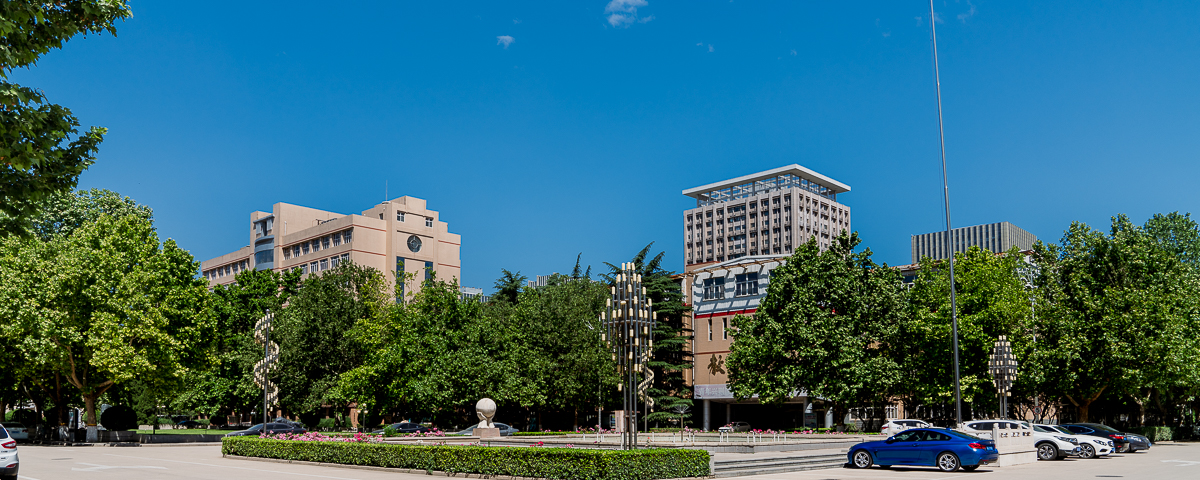


Hebei GEO University is a university co-established by the Ministry of Natural Resources and the People's Government of Hebei Province, and is a key provincial university. It is one of the domestic first-class universities supported by Hebei Province. Renowned geologist and Academician of the Chinese Academy of Sciences, Li Tingdong, serves as the honorary president of the university.
The university was founded in 1953. It originated from the Xuanhua Geological School established by famous geologist Li Siguang and revolutionary leader He Changgong in the ancient city of Xuanhua, located outside the Great Wall. It was one of the five key universities directly under the Ministry of Geology that set up economics and management programs in the early years of New China. In 1971, it was renamed Hebei Geological Institute, and in 1985, it moved from Xuanhua to Shijiazhuang, the provincial capital. In 1996, it was renamed Shijiazhuang Economic Institute, and in 2016, it officially became Hebei GEO University.
The university has consistently adhered to the core mission of "providing talent and technological support for the sustainable development of resources and the environment." It embraces the school motto "Da Guan Bo Wu" (Broad Vision, Extensive Knowledge), promotes the "Admiring Mountains and Water" culture, and has established a "dual geography" educational positioning—serving the geological industry and regional development while training compound talents with practical applications. The school follows the work philosophy of "consolidating the foundation, enhancing connotations, planning development, and elevating the university’s level," with a focus on integrating geology and economics, and on building a "industry-education integration, science-education integration" brand of talent cultivation.
Hebei GEO University has been approved as a project unit for doctoral degree authorization in Hebei Province. It offers programs in eight disciplines: Science, Engineering, Management, Economics, Law, Literature, Arts, and Education. It has 12 first-level master’s degree disciplines, 13 master’s professional degree types, and has the right to confer master's degrees based on equivalent academic qualifications. The university offers 70 undergraduate programs. The university’s disciplines in "Geology," "Geological Resources and Geological Engineering," and "Business Administration" are part of the provincial plan for building first-class domestic disciplines. "Geology" is a key supported discipline, while "Geological Resources and Geological Engineering" and "Business Administration" are key nurturing disciplines. The university also has nine provincial key disciplines, nine programs selected as national first-class undergraduate programs, 16 programs chosen for provincial first-class undergraduate construction, and several nationally recognized specialties. Additionally, four engineering programs have passed accreditation by the Ministry of Education.
Currently, the university has about 18,000 full-time students and over 1,700 staff members, of whom more than 50% of the faculty hold senior professional technical positions, and over 55% have doctoral degrees. The university has attracted 60 outstanding talents through full-time or flexible recruitment, including Academicians of the Chinese Academy of Sciences such as Li Tingdong and Liu Jiaqi, winners of the Li Siguang Geological Science Award, Song Mingchun, and prominent experts like Ji Qiang, a "German Humboldt Scholar" and "National Outstanding Youth," along with 187 part-time and visiting professors, including 14 academicians. Two teaching teams have been selected for the national "Huang Danian-style Teacher Team" recognition.
The university has 16 teaching units, five research institutes, eight teaching support units, and one independent college. It houses 23 provincial and ministerial-level scientific innovation platforms and social science research bases, including the "Key Laboratory for Intelligent Underground Space Detection and Equipment in the Beijing-Tianjin-Hebei Urban Agglomeration," as well as 1 Education Ministry Regional and Country Studies Center. The university also has two national-level experimental teaching demonstration centers and five provincial-level centers. The Earth Science Museum and Qian Yuan Financial Museum are key to the university’s science popularization efforts, with the Earth Science Museum being a national, provincial, and city-level base for popular science education. The library holds over 8 million volumes, including paper and electronic books, over 1,400 paper journals, 30,000 geological resources, and access to over 15,500 international and Chinese electronic journals.
In recent years, the university has received six national awards for scientific and technological progress, natural science, and teaching achievements. Two academic papers were published in the prestigious international journal Nature. The university has implemented the "Four Ones" initiative for cultivating top scientific research teams, which includes the "Shanhai Teams" led by Ji Qiang (paleontology) and Song Mingchun (gold exploration), contributing significant findings, such as Ji Qiang’s research on the ancient human skull "Longren," which provided crucial evidence for understanding human origins and evolution.
The university is committed to expanding its global academic presence and has established cooperative relationships with over 20 universities and research institutions in the UK, US, Canada, Germany, Russia, Australia, France, South Korea, and the Czech Republic. It also has broad partnerships with over 100 enterprises, universities, and research institutes in China, including the China Geological Survey, China University of Geosciences (Beijing), and the China Geological Academy. The university has also set up a Confucius Classroom at the University of Ostrava in the Czech Republic.
Over the past 70 years, the university has cultivated over 200,000 graduates, with alumni active in various fields around the world, including distinguished figures like Wu Qiang, Mao Jingwen, Xie Yuhong, Hou Zengqian, and Cheng Qiuming, all of whom have made notable contributions in their fields.
The construction and development of the university have received warm support from leaders at all levels. Prominent leaders such as Mao Zedong, Hu Jintao, and Xi Jinping have met with the university's faculty and students. Notably, in 2012, student Tang Jianzhe was personally received by President Xi Jinping, and former Premier Wen Jiabao donated a collection of rock and mineral specimens along with his Wen Jiabao’s Geological Notes to the university.
The university’s faculty and staff, following the spirit of diligence, pragmatism, unity, and innovation, strive to build Hebei GEO University into a "provincial first-class, nationally renowned, internationally influential, and innovative multi-disciplinary university with outstanding strengths in resources, environment, and related fields."
(Updated by the Party Publicity Department in November 2024)
ابدأ المحادثة
كن أول من يشارك أفكاره!