


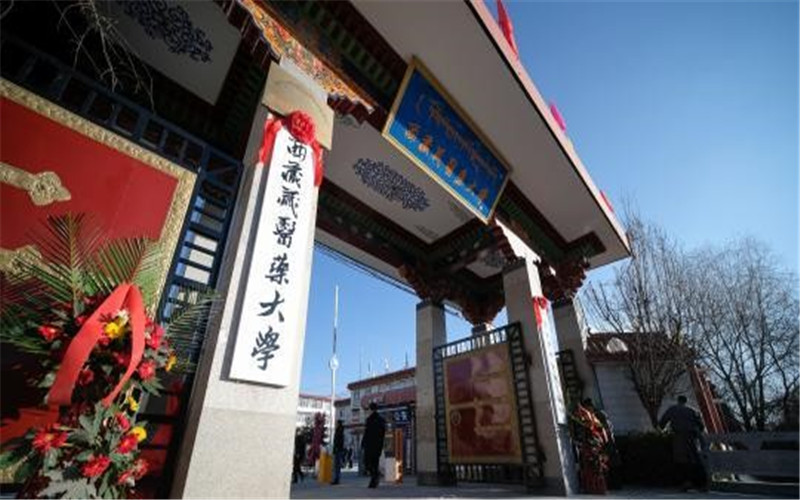

Located in Lhasa—the "City of Sunlight," situated on the snow-capped plateau and the "Roof of the World"—the Tibetan Traditional Medical University (TTMU) is the pioneer and leader of higher education in Tibetan medicine in China. It is the only standalone university of Tibetan medicine in the country and the sole higher education institution in the world with a comprehensive Tibetan medicine system. Particularly since the 18th National Congress of the Communist Party of China (CPC), the university has successively become an institution jointly constructed by the National Administration of Traditional Chinese Medicine and the People's Government of the Tibet Autonomous Region. It serves as a pilot unit for the "Tibetan Medicine Talent Cultivation Model Reform" under the national education system reform, an experimental zone established by the Ministry of Education for integrating traditional and modern elements into a modern higher education system and talent cultivation model for Tibetan medicine, a key discipline unit for traditional medicine under the National Administration of Traditional Chinese Medicine, and a continuing education base for advantageous disciplines in Tibetan medicine. Furthermore, it is the "Collaborative Innovation Center for Tibetan Medicine Research," co-constructed by the Ministry of Education and the Regional People's Government.
History & Campus Development The university's predecessors were the Tibet Autonomous Region Tibetan Medical School (founded in 1983) and the Department of Tibetan Medicine at Tibet University (founded in 1985). In 1989, the school and department merged to form the Tibetan Medical College of Tibet University. In 1993, it became an independent institution named Yaowangshan Tibetan Medical College. It was renamed Tibet Tibetan Medical College in 2001, and finally, Tibetan Traditional Medical University in 2018. In 2019, the state invested 1 billion RMB to construct a new campus, to which the university has now fully relocated. The state also invested 168 million RMB to build the Tibet Tibetan Medicine Museum within the new campus. Since its establishment, the university has consistently operated at the height of national development strategy, holding fast to the frontlines of high-level education in Tibetan medicine and creating a global highland for cultivating Tibetan medicine talent. It provides talent and intellectual support to domestic sister universities, research institutes, industry enterprises, and grassroots medical services.
Mission & Educational Philosophy The Tibetan Traditional Medical University adheres to the educational purpose of "being based in Tibet, facing the whole country, stepping into the world, and serving human health, economic construction, social development, cultural inheritance, and scientific and technological progress." It carries forward the university motto of "Great Virtue, Diligent Study, Earnest Practice, and Benefiting the Public." While primarily focusing on undergraduate education in Tibetan medicine, the university is accelerating the development of graduate education, actively expanding continuing education, and striving to create conditions to enroll international students. It aims to deepen the development of first-class disciplines in Tibetan Medicine and Tibetan Pharmacy, consolidate foundational support disciplines, and expand interdisciplinary studies, striving to become a top-tier university of Tibetan medicine with prominent features, distinct advantages, and strong comprehensive strength.
Medical & Teaching Facilities The university boasts an extensive network of facilities, including:
-
1 directly affiliated hospital
-
1 directly affiliated Tibetan pharmaceutical factory
-
1 Tibetan medicine education and teaching practice base
-
6 non-directly affiliated hospitals, 4 teaching hospitals, and 16 internship hospitals
-
1 national clinical teaching demonstration and training center for traditional medicine
-
1 teaching pharmaceutical factory and 2 internship pharmaceutical factories
-
1 Tibetan medicinal herb planting base
-
1 Tibet Tibetan Medicine Museum (under construction)
-
Note: The university is also the leading unit of the provincial collaborative group for the first batch of national emergency education pilot schools.
Academic Programs & Degrees The university has developed a multi-level education system with undergraduate education as its mainstay, coordinated with the development of graduate and continuing education. It has cultivated nearly 10,000 high-level specialized talents in Tibetan medicine who are politically qualified, professionally proficient, innovative, and dedicated. The university offers 2 first-level disciplines (Tibetan Medicine and Tibetan Pharmacy), 1 doctoral degree program (Traditional Chinese Medicine - Tibetan Medicine), 2 academic master's degree programs (Traditional Chinese Medicine - Tibetan Medicine, Traditional Chinese Pharmacy - Tibetan Pharmacy), 1 professional master's degree program (Traditional Chinese Medicine - Tibetan Medicine), and 1 postdoctoral research station. It offers 6 undergraduate majors: Tibetan Medicine, Tibetan Pharmacy, Nursing, Marketing, Integrated Traditional (Tibetan) and Western Medicine, and Traditional (Tibetan) Pharmaceutical Manufacturing. It also offers 1 higher vocational program and various levels of correspondence degree education. Notably, Tibetan Medicine and Tibetan Pharmacy are recognized as national first-class undergraduate majors.
Faculty & Expertise Adhering to the strategy of strengthening the university through talent, TTMU has built a faculty team with strict professional ethics, solid theoretical foundations, dedication to teaching and research, and broad perspectives. There are 311 faculty and staff members on payroll (including 12 cadres aiding Tibet), of which 169 are full-time teachers and technical personnel. Teachers with master's or doctoral degrees account for 65% of the faculty. The university is home to over 60 distinguished personnel, including Masters of National Medicine, National Famous Traditional Doctors, Qihuang Scholars, Famous Regional Tibetan Doctors, national-level candidates of the "New Century National Hundred, Thousand, and Ten Thousand Talent Project," National Famous Teachers, and recipients of the National "May Day Labor Medal." Over the past five years, 52 cadres from 6 counterpart-assistance universities have joined the university's development, and 28 experts have been flexibly introduced to play a leading role.
Student Body & Academic Competitions The university currently enrolls over 2,600 students, including more than 300 graduate students. It has developed 8 regional-level and 10 university-level excellent courses. The faculty has served as chief editors or participated in compiling 26 planned textbooks for 21st-century undergraduate Tibetan medicine education, 10 for undergraduate Tibetan pharmacy, 2 national undergraduate teaching syllabi, and 14 graduate textbooks, winning multiple national and regional awards. Over the past five years, teachers and students have won over 30 national awards and more than 60 regional awards in various academic competitions. The graduate employment rate has stably remained above 98%.
Research Platforms & Funding The university has established 6 provincial and ministerial-level research platforms, including the Ministry of Education Key Laboratory of Basic Tibetan Medicine and the Ministry of Science and Technology Key Laboratory of Tibetan Medicine and Plateau Biology. It has formed 9 major research fields and 11 academic development directions, establishing 2 disciplines supported by national special funds, 8 key disciplines under the National Administration of Traditional Chinese Medicine, and 2 regional key disciplines. TTMU has undertaken 367 major scientific research projects (including the "863 Program," "973 Program," and National Natural Science Foundation projects), with total approved funding of nearly 90 million RMB. Its research achievements have won over 40 national, provincial, and ministerial science and technology awards.
Standardization & Public Health Contributions Bearing the crucial task of championing the originality of Tibetan medicine, the university serves the "Healthy China" strategy and the construction of a Healthy Tibet. It has led the development of 2 international diagnostic and treatment standards and participated in formulating 7 industry standards, advancing the normalization and standardization of Tibetan medicine. The university continuously conducts health and cultural awareness campaigns, delivering over 20 health interviews or lectures annually on central and provincial media platforms. It actively promotes the commercialization of scientific research, developing Tibetan medicine products such as "Rinchen Drangjor (Pearl 70)" and "Tsothel," obtaining 26 National Medicine Approval Numbers and 81 hospital preparation filing numbers.
Strategic Partnerships & Global Outreach Seizing national opportunities for traditional medicine innovation, the university has deepened collaborative research with institutions regionally and nationally. It has established strategic partnerships with over 60 sister universities, medical institutions, pharmaceutical enterprises, and research units. TTMU has set up internship bases in over 20 hospitals (including the Beijing Hospital of Tibetan Medicine). It jointly trains students with institutions like Beijing University of Chinese Medicine and Jiangxi University of Chinese Medicine, and maintains close ties with over 20 domestic universities. Internationally, it has mutual exchange relationships with over 10 universities in countries like South Korea and South Africa, dispatching 57 faculty members abroad. The university is also a member of the Alliance of Traditional Chinese Medicine Universities in Western China.
Awards & Recognitions The university has been repeatedly honored with titles such as the National Advanced Unit for Ethnic Unity and Progress, Regional Civilized Campus, Regional Safe Campus, and Regional Advanced Collective for Employment and Entrepreneurship. It is a second-batch pilot unit for virtual teaching and research office construction under the Ministry of Education, and an initial provincial training base for school emergency education. Its non-directly affiliated Shannan Tibetan Hospital serves as a national clinical teaching demonstration and training center.
Future Outlook Looking to the future, the Tibetan Traditional Medical University will continue to deeply implement Xi Jinping Thought on Socialism with Chinese Characteristics for a New Era and the guiding principles of the 20th CPC National Congress. Centering on the "Four Major Issues" of the Tibet Autonomous Region and the overall deployment of the "Four Creations," the university adheres to the fundamental task of fostering virtue through education. Committed to its "Three-Step" development strategy, TTMU focuses on talent cultivation, prioritizes scientific research, relies on social service, utilizes cultural inheritance as a vehicle, and embraces international cooperation. It is striving to build a world-class Tibetan Traditional Medical University and write a new chapter in the development of higher education for the traditional medicine of the Chinese nation.
ابدأ المحادثة
كن أول من يشارك أفكاره!