


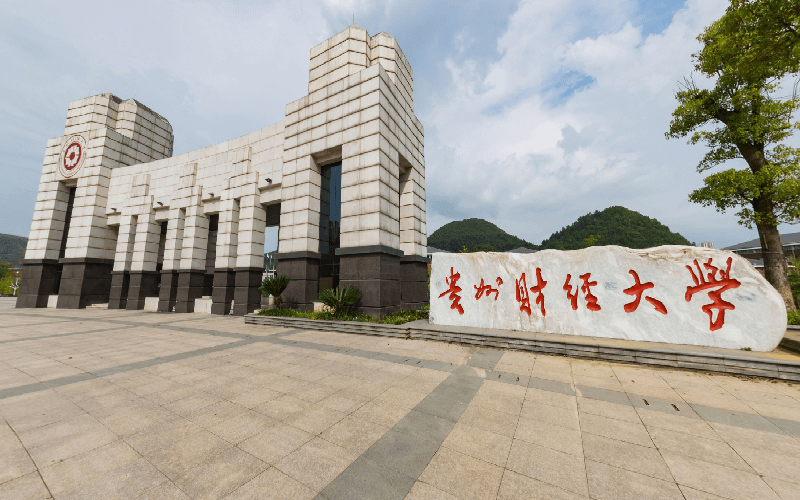
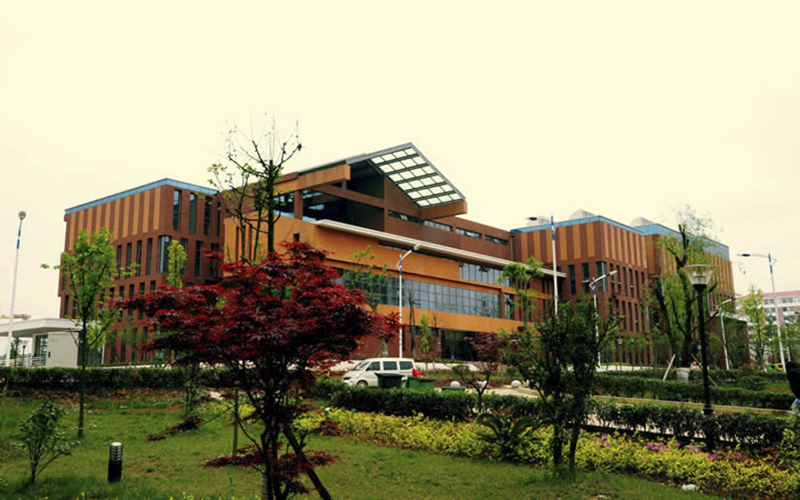


Guizhou University of Finance and Economics (贵州财经大学), founded in 1958 and originally named Guizhou University of Finance, was officially renamed in 2012 with approval from the Ministry of Education. It is a key talent cultivation base for economic management in Guizhou Province, supported by the Guizhou Provincial Party Committee and Government. The renowned economist and recipient of the Sun Yefang Economic Science Award, Professor Hong Yinxing, former Party Secretary of Nanjing University, serves as the Honorary President of the university.
The university adheres to the "Guizhai Spirit" of hard work, rigor, and perseverance, upholding the motto "Virtue, Broad Learning, Diligence, Innovation," with a focus on serving the Southwest and the broader national community. It is committed to nurturing "scholarly and entrepreneurial talent" to contribute to the prosperity of Guizhou and China. Over the years, the university has trained and educated over 100,000 talented individuals, making significant contributions to economic and social development in the Southwest, the Pearl River Delta, the Yangtze River Delta, and China’s securities industry.
The university spans a total area of 5,939 acres and operates several key academic institutions, including the Big Data and Statistics College, co-established with the National Bureau of Statistics and the Guizhou Provincial Government. It also hosts the Guizhou University of Finance and Economics - Western Michigan University College, a Sino-foreign cooperative institution approved by the Ministry of Education, and three postdoctoral research stations in business administration, theoretical economics, and public administration approved by the Ministry of Human Resources and Social Security. The university offers 20 colleges and has a student body of 21,916 full-time students, including 115 doctoral students, 3,193 master’s students, 18,572 undergraduates, and 31 international students. The faculty consists of 1,998 staff members, with 1,363 full-time teachers, 760 holding senior academic titles, and 702 with doctoral degrees.
The university has a strong emphasis on academic development, with the "Engineering" discipline ranked in the top 1% globally in the ESI (Essential Science Indicators). It has 3 doctoral-level programs, 11 master’s degree programs, and 20 specialized master’s programs, along with numerous recognized key disciplines at the provincial and national levels. With 69 undergraduate programs spanning 8 categories, the university is home to 19 national first-class undergraduate programs, 6 national characteristic programs, and 22 provincial-level teaching awards.
In research, the university hosts 10 provincial-level key laboratories, 1 provincial-level engineering research center, and 3 provincial-level collaborative innovation centers. Its research focuses on green development, ecological economics, inland open economy, digital economy, big data applications, and internet finance. The Journal of Guizhou University of Finance and Economics is indexed in major Chinese academic databases, including the CSSCI and other national indexes.
The university is also deeply involved in social services, cooperating with the Guizhou Provincial Government and other local entities in various social evaluation and consulting projects. It works on several key governmental programs related to poverty alleviation and regional economic development.
Guizhou University of Finance and Economics has expanded its international reach by establishing strategic partnerships with top universities and research institutions, including Nanjing University, the Central University of Finance and Economics, and Western Michigan University. It offers a variety of international programs, including Sino-foreign joint ventures with institutions in the U.S., the U.K., and other countries.
Looking ahead, the university will continue to uphold the leadership of the Communist Party, follow the direction of socialist education, and enhance its capacity for talent cultivation, scientific research, and social service. It aims to become a high-level, distinctive university specializing in finance and economics, contributing to the national and global development in the years to come.
Commencez la conversation
Soyez le premier à partager vos réflexions !