

Sanda University was originally founded in June 1992 by professors from Shanghai Jiaotong University, Peking University and Tsinghua University, as the first full-time private institution of higher education in Shanghai, under the background of the development and opening up of the Shanghai Pudong District. It was approved and endorsed by the Ministry of Education in March 2002 as a full-time regular undergraduate institution, which is the first undergraduate private institution of higher education in Shanghai. The University was authorized as a higher education institution to confer bachelor’s degree in 2005. In 2015 and 2020, it passed the undergraduate education evaluation and assessment by China’s Ministry of Education. In 2017, it was brought into the master's training unit of Shanghai Municipal Education Commission. In September 2024, it was approved by the Academic Degrees Committee of the State Council to be added as a master's degree-granting unit. Three master's programs have been approved for enrollment, which are Finance, Electronic Information and Nursing.
Sanda is a homophone of the three major characters, symbolizing the spirit of the cedar tree, which is upright, independent, and self reliant. Academician Yang You, Academician Xie Xide, and Academician Ni Weidou successively served as the first three presidents of the University. In the past 33 years since its establishment, Sanda strictly abides by the principles that the education of the institution is for the public welfare and always in the non-profit nature, adheres to the school-running philosophy of integrity, fairness, and quality. Sanda is positioned to become a multidisciplinary, international, and high-level university of applied sciences. The University's vision is to become the most attractive private university in the Yangtze River Delta region, and the mission of the university is to let every student harvest the growth suitable for their own. Sanda lays a 1+M+N (major+minor+practical skills) training path for students, so that they can become reliable, practical, and steadily-strive applied talents.
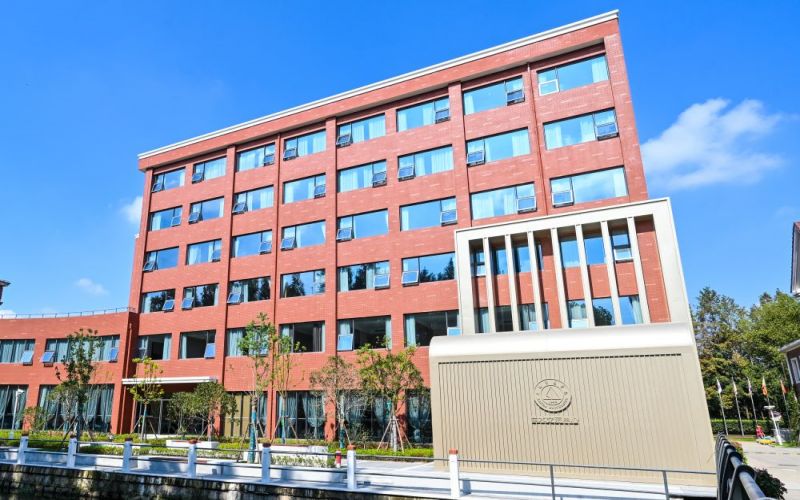
The University has two campuses, one in the Pudong District of Shanghai and the other in Jiashan County, Zhejiang Province, covering a total area of 133 acres. The University has 8 academic fields of study including Economics, Law, Literature, Engineering, Management, Art, Medicine and Education, offering 44 undergraduate majors, 1 Sino-US Cooperation Program, 6 junior college majors. It has 13 schools with more than 16,000 full-time students, including more than 15,000 undergraduates (94.3%). The university has cultivated more than 68,000 graduates, the average employment rate in the past five years has exceeded 96%. There are more than 960 full-time faculty members working for the university, 36% of them own high-grade professional titles, and 35% have received doctoral degrees.
Sanda has 2 national first-class undergraduate major construction sites; 15 Provincial First-Class Undergraduate Major Construction Majors; 27 First-Class Undergraduate Courses among Shanghai Universities; 58 Key Courses; 9 Ideological and Political Demonstration Courses; the first prize of the National Excellent Textbook; 4 Municipal Teaching Achievement Awards, including 2 first prizes and 2 second prizes (2022); 1 Shanghai First-Class Undergraduate Construction Leading Plan Cultivation Project; 2 Shanghai New Engineering and New Liberal Arts Teaching Reform Projects; 1 Pilot Project for the Construction of the First Municipal Virtual Teaching and Research Office. Sanda was selected as one of the first batch of key experimental universities for the construction of Ideological and Political Courses; Shanghai Curriculum Ideological and Political Education Research Demonstration Center. The University was approved National Social Science, National Natural Science, and Shanghai Natural Science Foundation Projects. More than 370 off-campus scientific research projects were approved, with a research funding of 26 million yuan. In 2023, students participated in discipline competitions, literary and sports competitions, and won nearly 400 awards at the provincial and ministerial level and above.
Sanda University has deepened the integration of industry and education, and cooperated with large enterprises in establishing HuDong Engineering College and School of Fashion. The University has also cooperated with top enterprises to establish Huawei ICT School, Huaqin School and other platform schools, and jointly built teaching hospitals with top tier hospitals such as Renji Hospital. The Modern Smart Service Industry School and the Fashion Consumer Goods Industry College have been approved as key modern industry school construction projects at the municipal level. There are over 160 experimental teaching centers on the campus, including Hotel Management Experimental Teaching Center, Mechanical and Electronic Engineering Experimental Teaching Center, Modern Medical Technology Comprehensive Experimental Center, and various professional teaching laboratories. The University has established a Collaborative Center for Ideological and Political Courses, and a High-quality Development Research Center of Shanghai Private Universities. The University has established inter-school cooperation and exchange relationships with 124 universities in 28 countries and regions, including 61 overseas cooperation programs. It has also collaborated with overseas universities to establish 8 bilingual teaching programs combining undergraduate and master's studies. The first overseas Confucius Classroom of Sanda University was approved in 2023 (in collaboration with the Chinese Culture and International Education Exchange Center in South Africa).
Sanda University has won such honorary titles as the founding and demonstration institution of Shanghai private institution of higher education; being rated as “Five A” Unit of Chinese social organizations; being a National Demonstration Unit of Open and Democratic Management; Shanghai Municipal “May 1st” Labor Award, Shanghai Civilized Campus; and Shanghai Municipal Model Institution of Governance by Law.
(Updated in January, 2025)
Commencez la conversation
Soyez le premier à partager vos réflexions !