
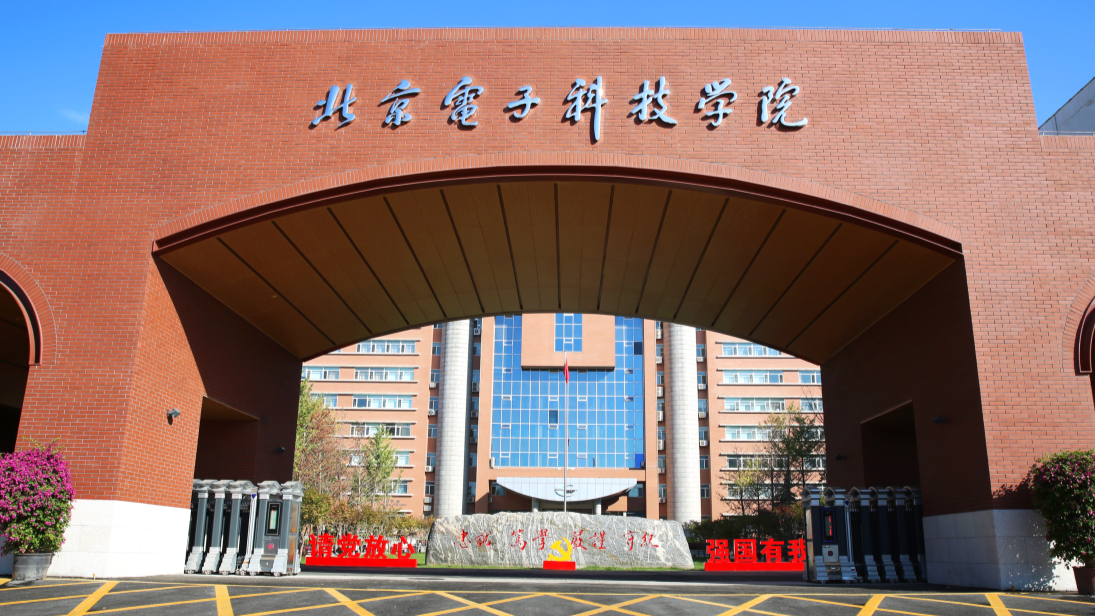


Beijing Electronic Science and Technology Institute (BESTI) is a regular institution of higher learning dedicated to training specialized personnel in cryptography, confidentiality, and information security for Party and government organs at all levels nationwide. The institute is affiliated with the General Office of the Communist Party of China (CPC) Central Committee.
Founded in August 1947, the institute originated from the Youth Cadre Training Class of the Central Working Committee. Over the past 70-plus years, it has gone through several development stages, including the Zhangjiakou Military Commission Engineering School, Beijing Electronic Vocational School, and Beijing Electronic Science and Technology Institute. In 2003, the institute began the joint training of academic master's degree students with Xidian University. In 2011, it independently launched pilot programs for professional master's degree training. In 2018, the institute was approved as a master's degree-awarding institution, and in the same year, began joint doctoral education programs with the University of Science and Technology of China and Beijing University of Posts and Telecommunications. In 2021, it was approved as a doctoral degree-awarding institution. Located at No. 7 Fufeng Road, Fengtai District, Beijing, the institute currently has over 2,000 full-time students.
Since its founding, the institute has consistently received cordial care and high attention from the leadership of the CPC Central Committee and its General Office. Comrades Mao Zedong, Deng Xiaoping, Jiang Zemin, Hu Jintao, and Xi Jinping have successively written inscriptions to encourage the institute or given important instructions regarding its work; Comrade Jiang Zemin also wrote the calligraphy for the institute's name. Central leading comrades such as Cai Qi and Ding Xuexiang, as well as successive leaders of the General Office of the CPC Central Committee including Qiao Shi, Wen Jiabao, Zeng Qinghong, Wang Gang, and Li Zhanshu, have provided numerous important instructions for the institute's construction and development and have visited multiple times to inspect its work.
The institute always bears in mind the heavy entrustment of the Party, fully implements the Party's educational policy, and firmly grasps the correct direction of running the school. Upholding the motto of "Loyalty, Diligence, Rigor, and Discipline" (忠诚、笃学、严谨、守纪), it adheres to the principles of building the institute politically, establishing it with distinctive characteristics, invigorating it with talent, strengthening it through reform, and governing it strictly. It strives to cultivate qualified talents who are politically loyal, academically solid, rigorous in style, and strictly disciplined, aiming to build itself into a well-known domestic university that is "specialized and unique, specialized and refined, specialized and excellent."
The institute currently has four departments and two teaching divisions: the Department of Cryptography Science and Technology, the Department of Cyberspace Security, the Department of Electronic and Communication Engineering, the Department of Management, the Ideological and Political Theory Teaching and Research Division, and the Humanities and Social Sciences Teaching and Research Division. It offers 8 undergraduate majors: Information Security, Cryptography Science and Technology, Electronic Information Engineering, Computer Science and Technology, Communication Engineering, Cyberspace Security, Secrecy Management, and Administrative Management.
The institute currently has 1 primary-discipline doctoral degree authorization point in Cyberspace Security, and 4 master's degree authorization points: Cyberspace Security, Cryptography, Electronic Information, and Public Administration (MPA). Among them, the professional degree authorization point for Electronic Information covers 3 fields: Next-Generation Electronic Information Technology (including quantum technology, etc.), Communication Engineering (including broadband networks, mobile communications, etc.), and Computer Technology. Concurrently, it jointly trains academic doctoral students in Cyberspace Security with the University of Science and Technology of China and Beijing University of Posts and Telecommunications, and continues to jointly train academic master's students in Information and Communication Engineering and Computer Science and Technology with Xidian University.
Among the full-time faculty, 87.9% hold master's or doctoral degrees, and 55.3% hold associate senior professional titles or above. To date, 22 teachers have received special government allowances from the State Council, and multiple teachers have been awarded titles such as "Beijing Famous Teaching Master," "Beijing Outstanding Teacher," and "Beijing Young Backbone Teacher."
Over the 70-plus years since its establishment, the institute has cultivated and delivered a large number of high-quality talents for the Party and the state. A number of advanced and exemplary figures at or above the provincial and ministerial levels have emerged from its alumni.
Start the conversation
Be the first to share your thoughts!