

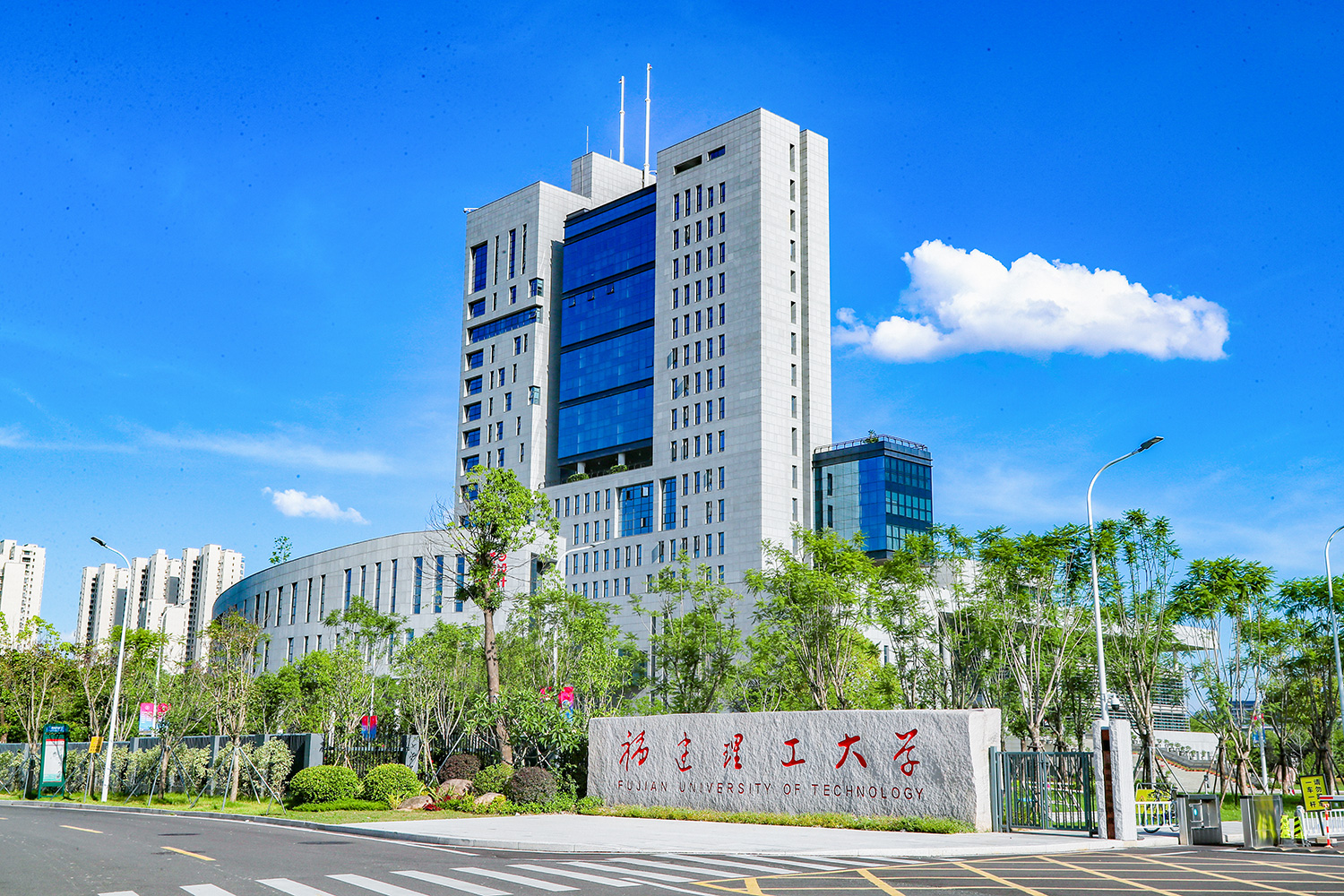



Fujian University of Technology is located in Fuzhou, a historical and cultural city known as the "Gateway to the Maritime Silk Road." It is a key provincial university with a focus on engineering, integrating science and engineering, and promoting multidisciplinary coordinated development. The university is one of the pilot institutions for the Ministry of Education’s "Excellence Engineer Education and Training Program," a university with first-class discipline construction in Fujian Province, and an A-level institution for applied discipline construction in Fujian Province.
The university has a long history, originating in 1896 from the "Cangxia Jing She" founded by local scholars Chen Bi, Lin Shu, and Chen Baochen during the late Qing Dynasty. It is recorded in the "Fujian Tongzhi" as the beginning of formal education in Fuzhou. In 1907, it began industrial education, becoming one of the first schools in China to do so. In the 1930s, it was known as the prestigious "Fujian Advanced Industrial School." After the founding of New China, it developed into the main institution for training technical and management professionals in the mechanical, electrical, and construction industries in Fujian. It became known as the "Cradle of Mechanical and Electrical Engineers" and "Huangpu Military Academy of the Construction Industry" in Fujian. Over time, the school has undergone several name changes and was upgraded to Fujian Engineering College in 2002. It was authorized to grant master's degrees in 2013 and renamed Fujian University of Technology in 2023. In September 2024, it was approved as a doctoral degree-granting institution in need of further development.
The university has 18 colleges (departments), with a total of 21,250 full-time students, including 2,304 graduate students. It has one doctoral program in a first-class discipline, seven master's degree programs in first-class disciplines, and 15 professional master's degree programs. These cover 19 fields of master's degree education. The university has eight national-level teaching platforms, including the National Experimental Teaching Demonstration Center and the National Virtual Simulation Experimental Teaching Center, among others. It also has 34 provincial-level teaching platforms, such as modern industry colleges, experimental teaching demonstration centers, and innovation practice platforms.
The university offers a wide range of disciplines, including engineering, management, literature, science, economics, law, and arts, with a focus on the "three pillars" of large mechanical and electrical engineering, civil engineering, and marine engineering, along with a distinctive focus on new liberal arts. Two of its disciplines, Engineering and Computer Science, are ranked in the top 1% globally in the ESI (Essential Science Indicators) rankings. Its civil engineering discipline is ranked in the 201-300 range in the Soft Science World’s "Top Global Disciplines" ranking, and its urban planning discipline is ranked in the top 50 of China’s best disciplines according to Soft Science.
The university has 13 national-level first-class undergraduate programs and has achieved great success in educational and teaching reforms, winning multiple national and provincial awards, including a second prize in the National Teaching Achievement Award. Over the past five years, it has received 36 awards for teaching achievements at the provincial level, including four special prizes.
The university continues to implement its "Talent-Strong School" strategy, with 1,359 full-time faculty members, 53.35% of whom hold doctoral degrees, and 47.61% with senior professional titles. It boasts over 100 national- and provincial-level talent awardees, including distinguished youth fund recipients, national-level "Hundred, Thousand, Ten Thousand Talent Project" members, and top scientists in the global top 2%. The university has also built 22 national and provincial-level innovation teams in teaching and scientific research.
The university plays an active role in serving regional industrial development and technological innovation. It has won significant national-level awards, including a second prize for National Science and Technology Invention. In the past five years, the university has secured 70 national-level projects, including national natural science funds, humanities and social sciences funds, key research and development projects, and international atomic energy agency projects. It has filed for 650 patents, and received 39 provincial-level science and technology awards.
The university has achieved remarkable success in student innovation and entrepreneurship, winning 343 international-level honors and 3,090 national-level awards in the last five years, including silver medals in the China International College Students Innovation and Entrepreneurship Competition and the "Challenge Cup" National College Student Extracurricular Academic Science and Technology Works Competition.
The university adheres to an open education philosophy, establishing partnerships with more than 50 universities and institutions in over 20 countries, including the United States, United Kingdom, Germany, Russia, Greece, and Kenya. It supports China’s Belt and Road Initiative by providing technical training to personnel in countries along the route. It also actively serves the development of cross-strait relations and has become a leading institution for Taiwan-based student recruitment.
With two campuses covering over 2,022 acres, the university has modern facilities and a total fixed asset value exceeding 1.964 billion RMB, with teaching and research equipment worth over 524.73 million RMB. The university has 31 Chinese and foreign language databases, over 22,000 electronic journals, 2.32 million paper books, and over 2.05 million electronic books.
In the new era, Fujian University of Technology is committed to promoting the development of high-level innovation-driven universities and contributing to the construction of a new, high-quality, and innovative institution that meets the needs of national and regional development.
(Data updated as of October 2024)
Start the conversation
Be the first to share your thoughts!