




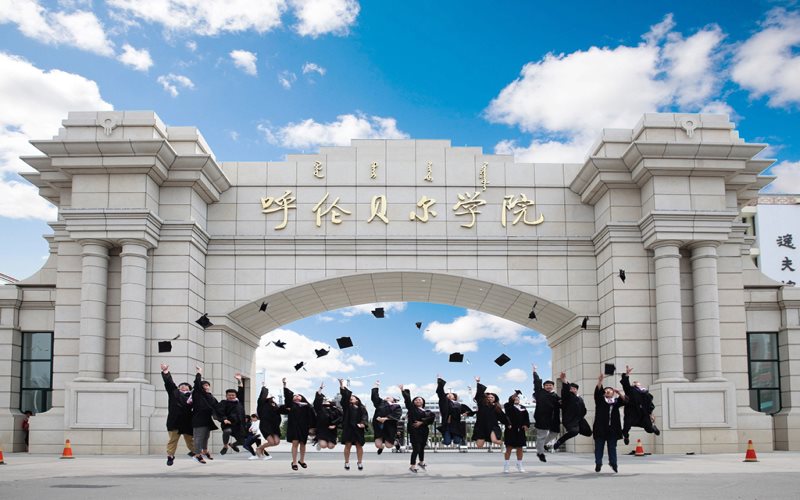

Hulunbuir College is located in the northern border of China, in the city of Hulunbuir, known for its beautiful grasslands and unique ethnic cultural charm. It is the only full-time comprehensive undergraduate institution in Hulunbuir City.
The college was founded in 1958 as Hulunbuir University and resumed undergraduate and diploma admissions in 1977. In 1992, Hulunbuir Education College, the Hulunbuir branch of the Inner Mongolia Radio and Television University, the Hulunbuir Management Cadre College, and the Heihe Normal College merged to form the new Hulunbuir University. In 1997, the institution was approved by the former State Education Commission and renamed Hulunbuir College. After 2000, several other schools, including the Heihe Mongolian Normal School, Hulunbuir Commercial School, Hulunbuir Urban Construction Worker Vocational School, Inner Mongolia Engineering and Technology School, and Hulunbuir Agricultural and Animal Husbandry Worker Vocational School, joined the college. In 2003, the college was approved by the Ministry of Education to become an undergraduate institution. In 2011, it passed the Ministry of Education's evaluation for undergraduate teaching quality. The college has deeply rooted itself in Hulunbuir, focusing on regional and industrial demands, and has promoted an application-oriented transformation. In 2016, it was selected as one of the first pilot universities for comprehensive transformation in the autonomous region. The same year, it was also chosen for the national "13th Five-Year Plan" for integrating production and education at application-oriented undergraduate colleges. In 2018, it passed the Ministry of Education's undergraduate teaching audit and evaluation. In 2021, the college was approved as a master's degree-granting institution. Over its 66 years of development, the college has trained over 100,000 professionals for society.
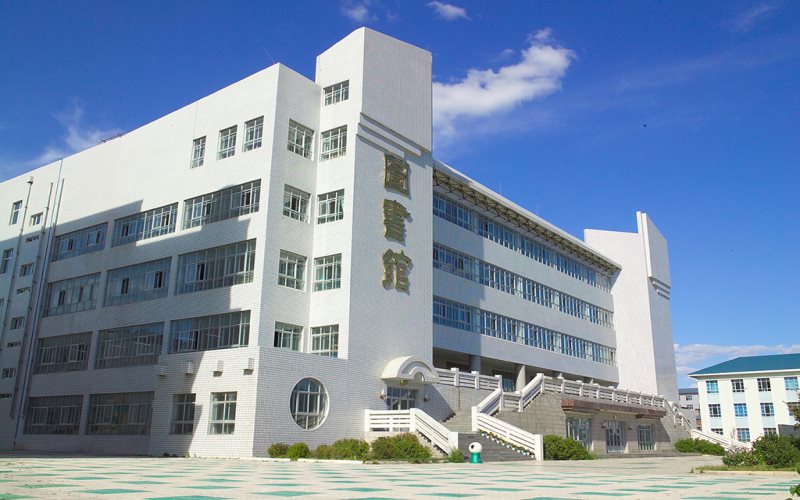
The college currently has three campuses, covering 761,500 square meters with a building area of 373,300 square meters, including 210,300 square meters of teaching and administrative space. The college comprises 18 colleges, one experimental training center, and three research centers. It offers 54 undergraduate programs across 10 major disciplines: Literature, Arts, Science, Education, Law, Engineering, History, Management, Economics, and Agriculture. The college is home to two national-level first-class undergraduate programs, 14 regional-level first-class programs, and four regional-level experimental teaching demonstration centers. It also hosts various specialized research centers, including the National “Belt and Road” Country and Regional Research Center, the National Grass Variety Regional Test Station, and the National Intangible Cultural Heritage Training Base, among others.
Hulunbuir College has nearly 14,000 full-time students, including 87 master's degree students. The faculty consists of 1,271 staff members, of which 804 are full-time teachers. Among the full-time faculty, 233 are dual-qualification teachers, 412 hold senior professional titles, and 696 have master's or doctoral degrees. The college boasts seven regional teaching masters, seven emerging teaching talents, and eight excellent teaching teams. It has won two first prizes, 11 second prizes, and seven third prizes for teaching achievements at the regional level.
In the past five years, the college has been approved for 17 national-level projects and 249 regional-level projects. It has added 10 new provincial-level research platforms and published 1,610 research papers, including 313 high-level papers. It has been granted 17 invention patents, 75 utility model patents, four design patents, and 315 software copyrights. The college has also won 218 various research awards at different levels, including three Excellent Achievement Government Awards in Philosophy and Social Sciences in Inner Mongolia.
The college actively engages in cooperation with local industries, building a collaborative environment for academic institutions, local governments, and society. It works on research projects that meet the needs of local economic and social development, which has led to increasing numbers of research projects and an expanding social impact. The college has also been involved in key technological breakthroughs for local industries, the transfer and commercialization of scientific research results, and the development of technology talents.
International exchange and cooperation are also a focus of the college, with partnerships established with universities in Russia, Mongolia, and other countries. For 11 consecutive years, the college has been rated as a "First-Level Foreign-Related Institution" by the Inner Mongolia Autonomous Region.
Guided by Xi Jinping's Thought on Socialism with Chinese Characteristics for a New Era, the college is committed to fostering national unity and the sense of a shared Chinese community. It follows the educational policies outlined by the 20th National Congress of the Communist Party of China and implements the major tasks assigned by President Xi to Inner Mongolia. The college emphasizes the importance of character development and moral education while promoting the "spirit of the Mongolian horse" and the "Three-North Spirit." With its motto "Pursue Virtue, Achieve Harmony, and Learn with Dedication," the college follows a student-centered approach, emphasizing reforms, innovation, and service to the local community. The college strives to become a distinctive, high-level application-oriented university, focusing on integrating academic disciplines, strengthening regional development, and contributing to Inner Mongolia's modernization.
Start the conversation
Be the first to share your thoughts!