






Jingdezhen Vocational University of Art (JVUA), abbreviated as "Jingyi Da" (景艺大), is a full-time, regular undergraduate institution approved by the Ministry of Education of China. It is managed by the Jiangxi Provincial Department of Education and operated by the state-owned enterprise Jingdezhen Ceramic Culture and Tourism Holding Group Co., Ltd. As a non-profit private institution, JVUA is also a key unit in the first batch of "School-Enterprise Collaborative Employment, Entrepreneurship, and Innovation Demonstration Practice Bases" designated by the Ministry of Industry and Information Technology’s SME Development Promotion Center. Additionally, it is one of the first "Dual-Teacher" teacher training bases in Jiangxi Province.
History
In 2001, with approval from the Jiangxi Provincial Development and Reform Commission and the Jiangxi Provincial Department of Education, the Jingdezhen Ceramic University established a full-time undergraduate institution, the Jingdezhen Ceramic University School of Science and Art. In 2020, after receiving approval from the Ministry of Education, the school was restructured into a higher vocational institution offering undergraduate programs, and was renamed Jingdezhen Vocational University of Art.
Campus Construction
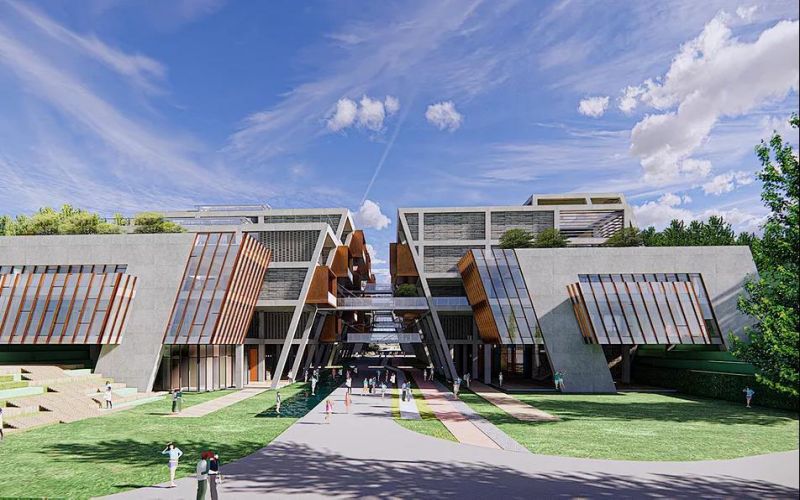
The university is located in Jingdezhen, a nationally recognized historic and cultural city in Jiangxi Province, covering an area of over 1,400 acres. The campus has a total building area of 917,000 square meters, with a library housing 970,000 physical books, 1,000,000 electronic books, and 270,000 Chinese electronic journals. The campus includes various advanced resources such as the China National Knowledge Infrastructure (CNKI) database, the SuperStar Digital Library, and eight other electronic resource databases. The campus features modernized teaching buildings, training facilities, sports venues, and a variety of specialized teaching instruments valued at approximately 180 million RMB.
The campus design integrates the natural landscape, preserving the original terrain and ecological environment. It features innovative architectural structures such as bridges and corridors built into the mountains, offering a dynamic, multi-functional, and space-efficient educational environment.
Talent Development
The university offers 29 general undergraduate programs, 31 vocational undergraduate programs, and 55 higher vocational programs, covering a broad range of disciplines including cultural arts, education and sports, civil engineering, media and communication, tourism, economics and business, electronics and information, manufacturing, energy and materials, environmental safety, public administration, and healthcare.
Rooted in Jiangxi but reaching across China, the university focuses on training high-level technical and skilled personnel needed for regional economic and social development. With an emphasis on applied arts, it integrates art and technology and aligns closely with industries such as new-generation ceramics, smart manufacturing, information technology, and modern services. The university also supports several specialized clusters, including ceramics technology, digital media, music and dance, intelligent manufacturing, and cultural tourism. There are 13 schools within the university, including the Marxism College, the Ceramic Arts College, the Digital Media College, the Music and Dance College, the Physical Education and Health College, and more.
School Characteristics
The university adheres to the Party's leadership, follows socialist educational principles, and implements comprehensive education policies. It focuses on cultivating high-quality, skilled talent and leverages the advantages of state-owned enterprises in its educational mission. By deepening industry-education integration and educational reform, the university continually upgrades its specialized clusters and explores diverse channels for school-enterprise collaboration. It partners with leading companies like Alibaba and Huawei to establish modern industry colleges, including the Digital Trade Industry College and the Digital Communication Industry College.
The university also promotes a holistic "three-dimensional" education model, integrating cultural, ideological, labor, and practical education. It provides immersive educational experiences through resources like organic farms, ecological tea gardens, museums, music halls, and art galleries. The university encourages innovation and entrepreneurship, creating broader opportunities for students' personal development.
Recent Honors
In recent years, the university has made significant strides in the innovation and development of vocational education. It has achieved remarkable results in talent cultivation, teaching, research, and Party building, contributing to the revitalization of Jingdezhen's ceramics industry and regional economic development. Students and faculty have earned numerous awards in national and provincial competitions in fields like arts and skills.
In 2022, the university won several prestigious awards, including first place in the provincial “Micro-class” competition and first place in the national finals of the China Robotics and AI competition. In 2023, it received recognition as a "National Outstanding Youth League Member" and earned national honors in various competitions, including the College Business Elite Challenge. In 2024, the university established Jingdezhen’s first full-ensemble symphony orchestra and achieved third place in the National College Students' Microfilm Contest.
The university has initiated more than 30 provincial and national research projects, published over 80 high-level academic papers, and received more than 200 awards in national and provincial competitions.
(Updated to July 2024)
p.s. formerly College of Technology and Art Jingdezhen Ceramic Institute
ابدأ المحادثة
كن أول من يشارك أفكاره!