



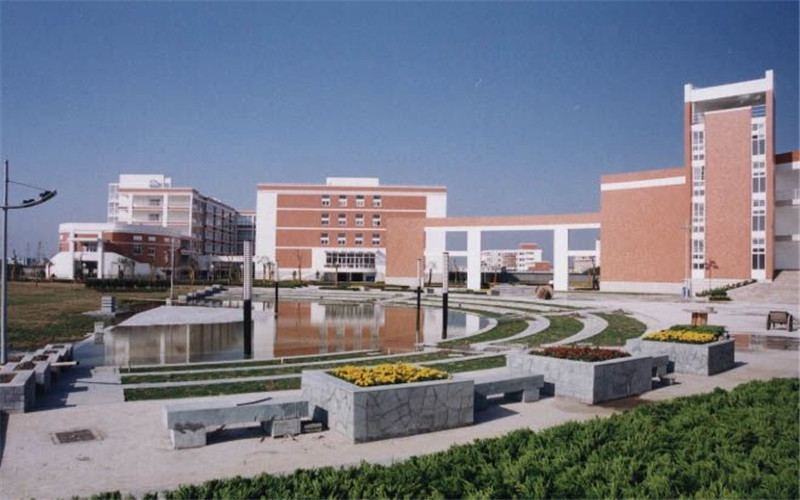

The School of Information Engineering at Hangzhou Dianzi University was established in 1999 with approval from the Zhejiang Provincial Government and was confirmed by the Ministry of Education as one of the first independent colleges in 2004. In July 2012, Hangzhou Dianzi University signed a cooperation agreement with the Lin'an Municipal Government to jointly establish the School of Information Engineering. In 2019, the school officially passed the provincial-level review for independent colleges’ regulatory setup. The school is located on the shores of Qingshan Lake in the science and technology innovation corridor in the western part of Hangzhou. It covers an area of 500 acres, with a building area of 174,800 square meters.
The school adheres to the spirit of Hangzhou Dianzi University, which emphasizes "study diligently and act decisively, uphold integrity and seek innovation," and follows the educational policy of "relying on the parent institution, maintaining relative independence, and developing distinctive features." Its mission is to "serve the region, stay close to the industry, and serve Zhejiang," with a goal of becoming a modern, innovative, and entrepreneurial university.
The school has developed a clear disciplinary structure, with a strong focus on electronic information and economic management. It currently offers 26 programs across five academic disciplines: engineering, economics, management, literature, and arts. The school has established six major clusters of undergraduate programs, including Computer Science, Mechanical Automation, Electronic Information, Economic Management, Art Design, and English. The school has two provincial-level first-class disciplines, one "13th Five-Year" emerging specialty program, three "12th Five-Year" specialty programs, and one "11th Five-Year" key construction program. It also has five provincial-level first-class undergraduate programs, 43 provincial-level first-class courses, and two micro-degree programs. The Qingshanhu campus hosts 98 laboratories, including seven joint labs, and is home to two provincial-level experimental teaching demonstration centers (Electronic Information and Industrial Internet Practice Teaching Demonstration Centers).
The school recruits students from 17 provinces, municipalities, and autonomous regions across China. As of September 2024, the school has 10,644 full-time undergraduate students. In 2024, the admission scores for the college ranked second among similar institutions in the province. The employment rate of the 2023 graduating class has achieved outstanding results, ranking among the top in the province. Over the past 20 years, the school has successfully trained more than 40,000 undergraduate graduates. According to a survey report published by the Zhejiang Provincial Education Evaluation Institute, the school performs excellently in career development planning and talent cultivation, ranking among the top in similar universities. The one-year follow-up participation rate and social security rate of its graduates are higher than the provincial average, and both student and employer satisfaction with the university have improved compared to previous years.
The school is committed to enhancing the quality of its faculty and actively recruits high-level talent. It currently employs 540 staff members (excluding part-time faculty), with 21.1% holding senior professional titles. Of the full-time faculty, 94.6% have master's or doctoral degrees, with 27.4% holding PhDs. The school has introduced two national-level experts. Over the past three years, faculty members have undertaken national-level projects such as the National Natural Science Foundation, 30 provincial and ministerial-level research projects, 1 spearheading leadership project, over 70 industry-government collaborative projects, and 7 technology transfer projects. Faculty have published more than 100 papers, including three in top-tier journals, and have received 10 awards, including the second prize for innovation from the China Invention Association and the second prize for the China Communications Society Science and Technology Award.
The school has achieved impressive results in academic competitions. According to the "2023 National College Student Competition Analysis Report," the school ranked third in China and first in Zhejiang Province among private and independent colleges, with a total of 430 awards and a score of 56.66. In 2023, the school won 557 provincial and national-level awards (a 25.17% increase compared to the previous year), including 155 national-level awards (a 29.17% increase). In the 2023 China International College Students Innovation Competition, the school won one gold and one silver medal, ranking second nationally among similar institutions.
The school continuously promotes the integration of industry and education, industry-university cooperation, and collaborative talent cultivation. It has established joint talent cultivation models with various enterprises and institutions, such as the "1+2+1" cooperative education program with the University of Electronic Science and Technology of China, the "3+1" cooperative education program with Hangzhou Dianzi University, and the "Computer Science and Technology (Zhongdian Joint Training Program)" with Shanghai Zhongdian Electronics System Technology Co., Ltd. It has also collaborated with Huawei Technologies Co., Ltd. to establish the ICT College and with Zhejiang Guoyan Laser Technology Co., Ltd. to build a LiDAR Technology Research Center. The school has signed cooperation agreements with 53 companies, including Hangzhou Forklift Group, Xizi Otis Elevator Co., Ltd., Lin'an NetEase Joint Innovation Center, and Zhejiang Libiao Robotics Co., Ltd., to jointly create internship and training bases. The school also has more than 6,000 square meters of innovation and entrepreneurship space to support student activities in these areas.
Facing new development opportunities and challenges, the School of Information Engineering at Hangzhou Dianzi University will continue to develop its distinctive educational characteristics, adhere to the fundamental task of fostering virtue and talent, improve undergraduate education quality, accelerate the development of its internal capacity, and work towards becoming a modern, innovative, and entrepreneurial university with a beautiful campus, a strong cultural atmosphere, and core competitive strengths.
(Note: Data as of September 2024)
Start the conversation
Be the first to share your thoughts!