
能愿动词(3):想
HSK 1基本语义及用法
表示希望、打算做某事的意愿,语气比“要”委婉。
It indicates the subject’s hope or plan to do something. Its tone is milder than 要.
典型例句和对话
| 例句 | ① 我想学中文。 | ② 我不想睡觉。 | ③ 你想去图书馆吗? |
| 交 际 实 践 |
(在学校) A:我想学中文。 Wǒ xiǎng xué zhōngwén. I want to learn Chinese. Quiero aprender chino. B:行,我们一起学吧。 Xíng, wǒmen yìqǐ xué ba. Sure, let’s learn together. Claro, aprendamos juntos. |
(在家) 妈妈:你怎么还不睡觉? Māma: Nǐ zěnme hái bù shuìjiào? Mom: Why are you still not sleeping? Mamá: ¿Por qué aún no duermes? 儿子:我不想睡觉,我想看一会儿电视。 Érzi: Wǒ bù xiǎng shuìjiào, wǒ xiǎng kàn yíhuìr diànshì. Son: I don’t want to sleep; I want to watch TV for a while. Hijo: No quiero dormir, quiero ver la tele un rato. |
(在教学楼) A:你想去图书馆吗? Nǐ xiǎng qù túshūguǎn ma? Do you want to go to the library? ¿Quieres ir a la biblioteca? B:好啊,我们现在就去吧。 Hǎo a, wǒmen xiànzài jiù qù ba. Sure, let’s go now. Claro, vamos ahora mismo. |
补充例句Additional sentences
① 我想去看电影。
Wǒ xiǎng qù kàn diànyǐng.
I want to go watch a movie.
Quiero ir a ver una película.
② 我想在家吃早饭。
Wǒ xiǎng zài jiā chī zǎofàn.
I want to have breakfast at home.
Quiero desayunar en casa.
③ 她不想喝牛奶。
Tā bù xiǎng hē niúnǎi.
She doesn’t want to drink milk.
Ella no quiere beber leche.
④ 他不想去中国。
Tā bù xiǎng qù zhōngguó.
He doesn’t want to go to China.
Él no quiere ir a China.
⑤ 你明天想去商场吗?
Nǐ míngtiān xiǎng qù shāngchǎng ma?
Do you want to go to the mall tomorrow?
¿Quieres ir al centro comercial mañana?
⑥ 你想不想吃米饭?
Nǐ xiǎng bù xiǎng chī mǐfàn?
Do you want to eat rice?
¿Quieres comer arroz?
结构特点
能愿动词“想”用在动词性成分的前边。
①肯定形式:
S + 想 + VP
我 想 学中文。
②否定形式:
S + 不想 + VP
她 不想 喝牛奶。
③正反疑问形式:
S + 想不想 + VP ?
你 想不想 吃米饭?

Related Grammar

“我们、你们、他们、她们”都是复数人称代词。“我们”指称说话者一方群体;“你们”指称听话者一方群体;“他们、她们”指称除说话者和听话者以外的其他人,这些人都是男性或有男有女时用“他们”,都是女性时用“她们”。

“我、你、您、他、她”都是单数人称代词。“我”指称说话者本人;“你、您”指称听话者,“您”是“你”的尊称,“他、她”指称除说话者和听话者以外的其他人,“他〞指称男性,“她〞指称女性。They are all singular personal pronouns. 我 means "I/me", 你 and 您 mean "you", the latter being the honorific form; 他 means "he/him" and 她 means "she/her".

用在疑问向中,用来询问地点和处所。“哪儿”更常用于口语。They are used to ask about places and locations. 哪儿 is more often used in spoken Chinese.

用在疑问句中,后面加上形容词,询问程度或数量,例如年龄、时间、高度、长 度、距离等。It is used in interrogative sentences, followed by an adjective, to ask about the degree or quantity such as age, time, height, length, distance, etc.

合成方位名词,表示处于上、下、里、外、前、后、左、右、东、南、西、北的 位置或方向。These are compound nouns of locality, indicating a position or direction that points upward / downward / inward /outward / forward / backward / leftward / rightward / eastward / southward / westward / northward.

用在疑问向中,用来对事物进行提问。It is used in interrogative sentences to ask about something.

用在疑问句中,询问数量,例如人数、价格 年龄等。或者不清楚到底有多少的数量It is used in interrogative sentences to ask about the quantity, such as the number of people price, age, etc. The number is normally larger than 10 or totally unknown.
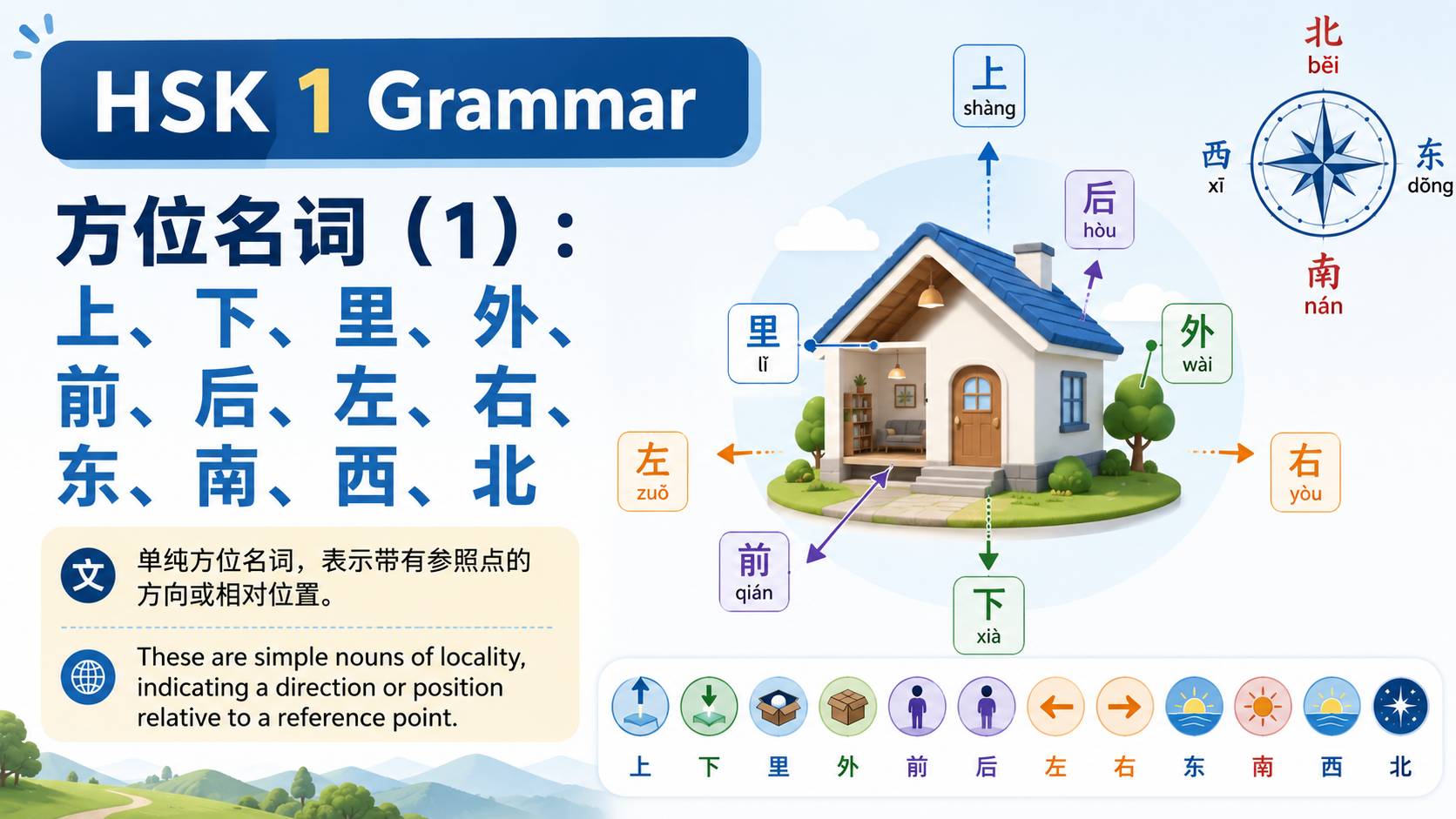
单纯方位名词,表示带有参照点的方向或相对位置。These are simple nouns of locality, indicating a direction or position relative to a reference point.

“哪”在疑问句中,常跟量词连用,用来询问人或事物,表示要求在一群人或一类事物中加以确指。In interrogative sentences, 哪 is often used with a measure word to ask about someone or something requiring to identify the person or thing among several options.
Start the conversation
Be the first to share your thoughts!