Today in History:1870 - The Franco-Prussian War breaks out

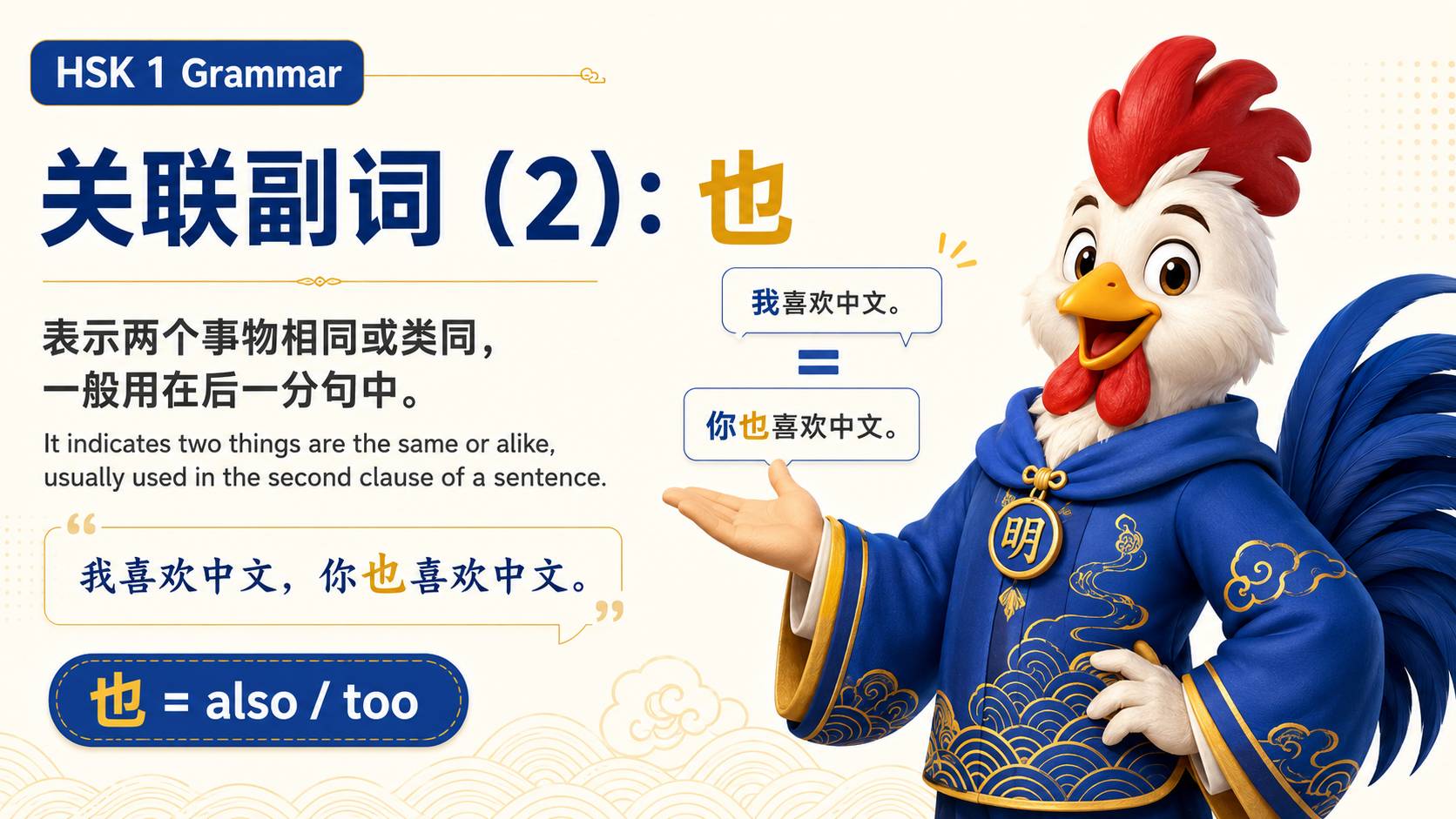
关联副词(2):也

HSK 1

基本语义及用法

Basic Meaning & Usage

表示两个事物相同或类同,一般用在后一分句中。
It indicates two things are the same or alike, usually used in the second clause of a sentence.

典型例句和对话

Example Sentences & Conversations

(Zài xuéxiào)
(在学校)
(At school)
A: Tā shì xuésheng ma?
A:他是学生吗?
A: Is he a student?
B: Tā shì xuésheng, wǒ yě shì xuésheng.
B:他是学生,我也是学生。
B: He is a student, and I am a student too.
(Zài jiàoshì)
(在教室)
A: Nǐ yǒu shū ma?
A:你有书吗?
A: Do you have a book?
B: Wǒ méiyǒu shū, yě méiyǒu běnzi.
B:我没有书,也没有本子。
B: I do not have a book, nor do I have a notebook.
(Zài fàndiàn)
(在饭店)
(En un restaurante)
A: Zǎofàn nǐ xǐhuan chī shénme?
A:早饭你喜欢吃什么?
A: What do you like to eat for breakfast?
B: Wǒ xǐhuan chī mǐfàn, yě xǐhuan chī miànbāo.
B:我喜欢吃米饭,也喜欢吃面包。
B: I like eating rice, and I also like eating bread.

补充例句

Additional Examples

Tā huì chànggē, yě huì xiě gē.
他会唱歌,也会写歌。
He can sing, and he can also write songs.
Wǒ bú shì xuésheng, tā yě bú shì xuésheng.
我不是学生,他也不是学生。
I am not a student, and he is not a student either.
Tā qù shàngkè le, nǐ yě yào qù ma?
他去上课了,你也要去吗?
He has gone to class. Are you going too?
Wǒ qù jīchǎng, nǐ yě qù jīchǎng ma?
我去机场,你也去机场吗?
I am going to the airport. Are you going to the airport too?
Zhège fángjiān hěn dà, yě hěn gānjìng.
这个房间很大,也很干净。
This room is very large, and it is also very clean.
Jiějie hěn hǎokàn, mèimei yě hěn hǎokàn.
姐姐很好看,妹妹也很好看。
The older sister is very pretty, and the younger sister is also very pretty.

结构特点

Structural Features

“Yě” yòng zài zhǔyǔ hòu, dòngcíxìng huò xíngróngcíxìng chéngfèn qián, zuò zhuàngyǔ. Qiánhòu fēnjù zhǔyǔ xiāngtóng shí, hòumiàn fēnjù de zhǔyǔ yìbān shěnglüè.
“也”用在主语后、动词性或形容词性成分前,作状语。前后分句主语相同时,后面分句的主语一般省略。
“也” is used after the subject and before a verbal or adjectival component, functioning as an adverbial. When the subjects of the two clauses are the same, the subject of the second clause is generally omitted.
S + VP/AP,也 + VP/AP
Wǒ méiyǒu shū, yě méiyǒu běnzi.
我没有书,也没有本子。
I do not have a book, nor do I have a notebook.
Zhège fángjiān hěn dà, yě hěn gānjìng.
这个房间很大,也很干净。
This room is very large, and it is also very clean.
S₁ + VP/AP,S₂ + 也 + VP/AP
Wǒ bú shì xuésheng, tā yě bú shì xuésheng.
我不是学生,他也不是学生。
I am not a student, and he is not a student either.
Jiějie hěn hǎokàn, mèimei yě hěn hǎokàn.
姐姐很好看,妹妹也很好看。
The older sister is very pretty, and the younger sister is also very pretty.

小提示

Tips

(1)Fǒudìngcí “bù, méi” fàng zài “yě” de hòumiàn. Lìrú:
否定词“不、没”放在“也”的后面。例如:
(1) The negative words “不” and “没” are placed after “也”. For example:
* Tā bú shì xuésheng, wǒ bú shì yě xuésheng.
* 他不是学生,我不是也学生。
* He is not a student, and I am “not also a student”. Incorrect word order.
Tā bú shì xuésheng, wǒ yě bú shì xuésheng.
他不是学生,我也不是学生。
He is not a student, and I am not a student either.
Liǎng ge fēnjù, yǒushí zhǔyǔ bùtóng, wèiyǔ xiāngtóng; yǒushí zhǔyǔ, dòngcí xiāngtóng, bīnyǔ bùtóng. Lìrú:
两个分句,有时主语不同、谓语相同;有时主语、动词相同、宾语不同。例如:
(2) In two clauses, sometimes the subjects are different while the predicates are the same, and sometimes the subjects and verbs are the same while the objects are different. For example:
Wǒ shì xuésheng, tā yě shì xuésheng.
我是学生,他也是学生。
I am a student, and he is also a student.
Wǒ méiyǒu shū, yě méiyǒu běnzi.
我没有书,也没有本子。
I do not have a book, nor do I have a notebook.
关联副词(2):也

Start the conversation

Be the first to share your thoughts!

Disclaimer